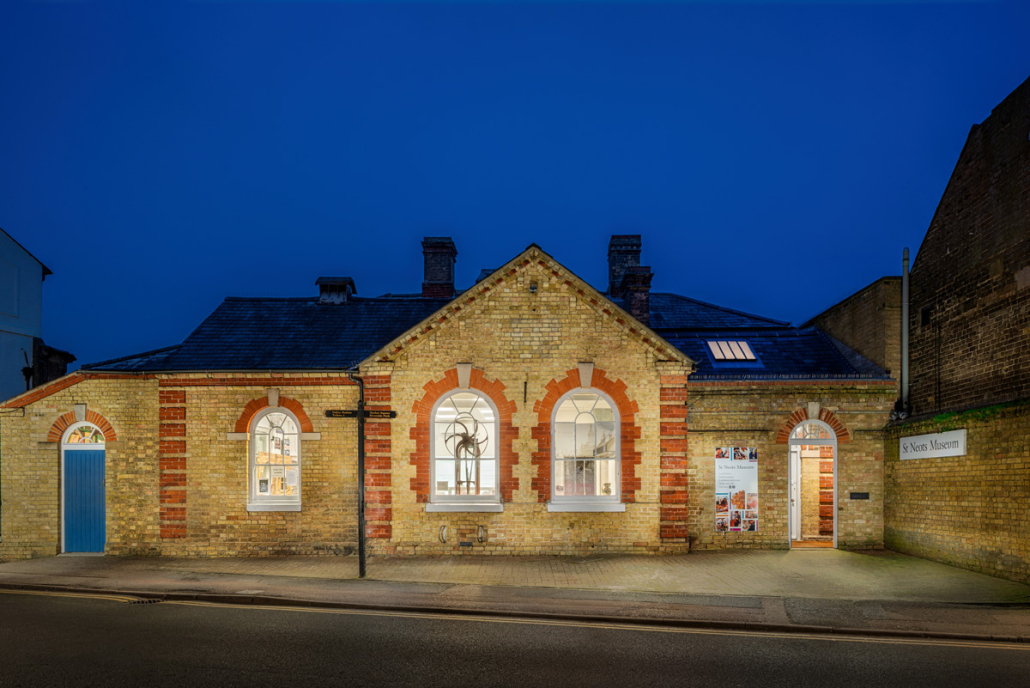
Capturing St Neots: inside Maciek Płatek’s process
Maciek Płatek is a Cambridgeshire-based photographer specialising in interiors, architecture, and commercial work. With a sharp eye for light and composition, he creates considered, detail-driven images for businesses and private clients across the region — and many local people will know him as the photographer behind the popular St Neots Instagram account.
His ongoing project to document the buildings and landscapes of St Neots is quietly building into a remarkable visual record of the town. This month, he took on one of his most technically demanding subjects yet: St Neots Museum.
A difficult building to shoot
The museum — a former police station and magistrates’ court — presents a genuine challenge for architectural photography. Squeezed into a busy town centre location, it sits directly on a main road, hemmed in by street furniture, parked cars, and passing traffic. There is no clean sightline, no easy angle, and very little room to manoeuvre.
Maciek’s solution was to lean into the constraints rather than fight them — and to choose his moment carefully.
Blue hour and the long exposure
He set up his tripod on the opposite side of the road during blue hour: that short window after sunset when the sky holds a deep, ambient glow that bridges natural and artificial light. It is a time of day Maciek returns to repeatedly because it lends architectural subjects a quality of atmosphere that full daylight or full darkness rarely achieves.
Blue hour demands a slow shutter speed — typically two to three seconds — to compensate for the low light levels. This is where the busy road stopped being a problem and became an asset. At those exposure lengths, passing cars dissolve into soft trails of headlight blur, adding movement and energy to the frame rather than cluttering it. The stillness of the building is held in contrast against everything in motion around it.
Setup took around twenty minutes. Then came the waiting.
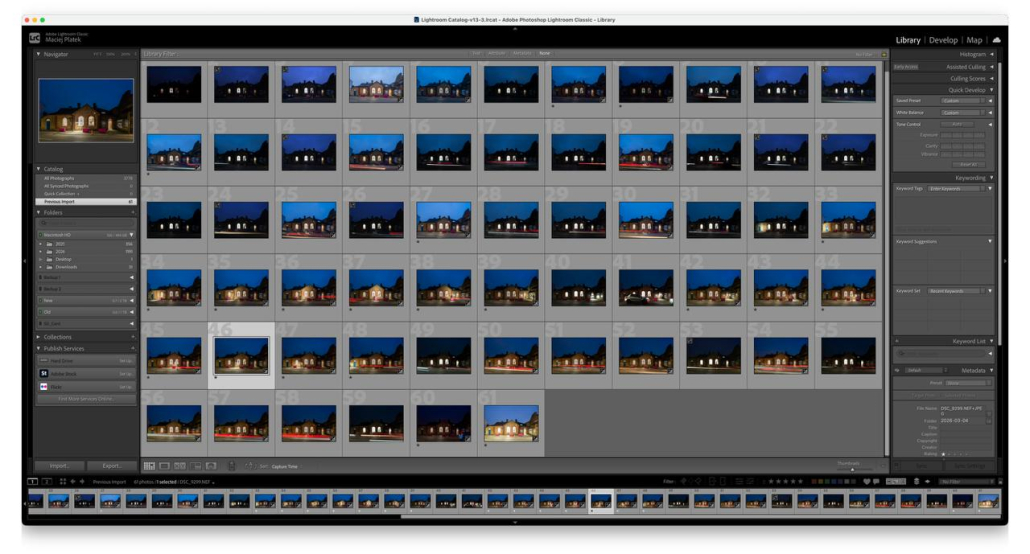
All 61 frames taken by Maciek Platek with different exposures and light levels.
Getting the light right
Timing, it turned out, was everything. The museum trustees happened to be meeting that evening, which meant the interior lights were on — warm, occupied, alive. For a building that can look cold and institutional in flat daylight, this was exactly the quality Maciek needed. The illuminated windows gave the facade depth and character, and created the kind of interior-to-exterior light balance that makes architectural photography genuinely difficult to achieve.
He shot methodically: fifty or so frames, some with passing cars in frame, some without, and some using a portable spotlight he had brought to selectively illuminate specific areas of the building’s surface. Those lit sections would give him more to work with in post-processing.
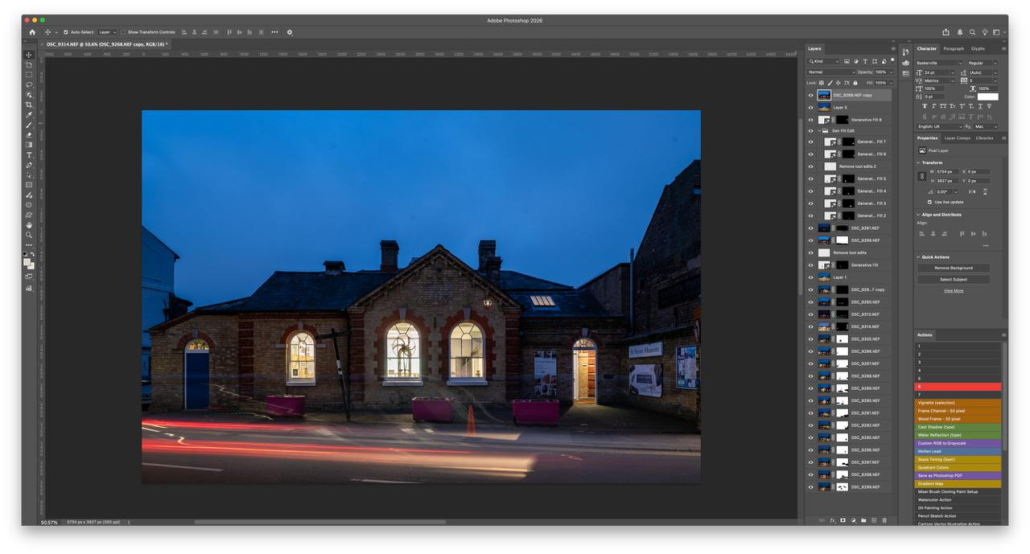
A single unedited frame that shows the light trails and under-exposed museum windows
The edit
Back at his desk, Maciek worked in Photoshop, drawing on a combination of traditional compositing techniques and AI-assisted tools to bring the final image together.
The core challenge in editing a blue-hour exterior shot is managing the exposure difference between inside and outside the building. The interior and exterior rarely land well in a single frame — windows either blow out or the facade goes dark. By blending multiple exposures, Maciek was able to hold both, retaining the warmth of the lit interior whilst keeping the exterior tones in the correct range.
Street furniture, signage, and visual clutter — including a security alarm box on the facade — were removed during retouching. This is a standard part of architectural post-processing: the goal is to reveal the building as it is, stripped of the temporary and the incidental. The spotlight shots allowed him to lift areas of shadow that the ambient light couldn’t reach.
Finally, selective tonal and colour adjustments were applied to unify the composite and bring the image to its finished state.
The result is one of the more technically accomplished images in what is becoming an invaluable photographic portrait of St Neots.
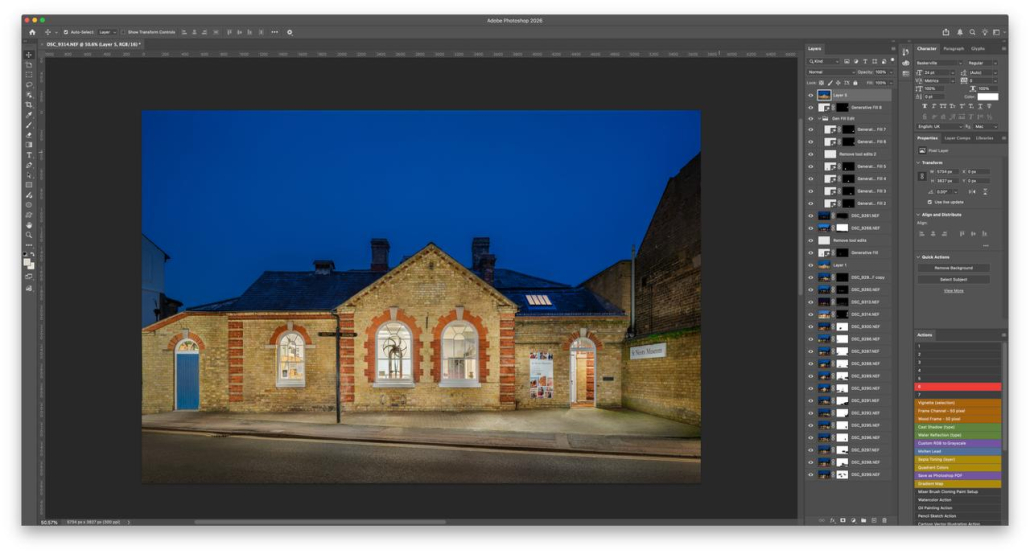
The final composite image showing all the layers in Photoshop required to get the final image.
Get your own print
You can follow Maciek’s work on Instagram or find out more about his commercial and private commissions here, visit his new online shop to purchase one of Maciek’s amazing photos of St Neots yourself, or pop into The Craft Shelf and browse his latest framed prints for sale.
