Local Plan to 2046: your chance to have your say before it goes to government

Huntingdonshire District Council has published the final version of its Local Plan to 2046, and it wants to hear from you before sending it off for independent examination.

The plan sets out where new homes and jobs will go across the district, which green spaces should be protected, how new developments should look, and how the area copes with climate change. Once it’s adopted, it becomes the rulebook councils use to decide planning applications, so it shapes what gets built and where for years to come.

This is officially called the “Pre-Submission” stage, or “Regulation 19” in planning terms. Councillors approved the document on 9 September 2026, opening a six-week consultation window that runs from Wednesday 16 September until 11.59pm on Wednesday 28 October 2026.

Earlier rounds asked what people thought the plan should include. This one is narrower and more technical: it asks whether the plan is legally sound. In planning terms, “sound” means the plan is positively prepared, meaning it tries to meet the area’s housing and other needs, working with neighbouring authorities where needed; justified, meaning it’s backed by evidence and has weighed up reasonable alternatives; effective, meaning it’s realistic and deliverable, with cross-boundary issues sorted out rather than left hanging; and consistent with national policy, meaning it follows the government’s national planning framework. Comments made now go straight to the Planning Inspectorate and the independent inspector who will examine the plan, so this really is the last formal opportunity to flag concerns before it’s out of the council’s hands.

Work on the plan started back in 2023. The most recent round, the Preferred Options consultation, ran from November to December 2025 and drew over 2,950 responses. Alongside that, 354 sites were put forward in a 2023 call for sites, with a further 68 added in 2025. All of that feedback has fed into the document now on the table.

The full package includes the Pre-Submission Local Plan to 2046 itself, plus a plain-English guide to help navigate it; a Sustainability Appraisal, assessing the plan against 16 environmental, social and economic objectives; a Habitats Regulations Assessment, covering the impact on protected nature sites; and an interactive policy map, showing site allocations, employment areas, town centres, heritage assets and more. Everything is available through the council’s online consultation portal, or you can view paper copies at Pathfinder House in Huntingdon, or request printed copies (postage and printing costs apply).

The council would rather you use the online portal, since it records and processes responses more reliably. If that doesn’t work for you, response forms are available by email or phone, and can be posted or emailed back. A few practical tips if you’re responding: be clear about which chapter, policy or site you’re commenting on; focus on legal compliance and soundness rather than general opinions about the plan; and suggest a specific change if you want one- the more precise, the better. One thing worth knowing is that comments can’t be made anonymously. Your name and any organisation you represent will be published alongside your comment, and your details will be shared with the Planning Inspectorate.

After the consultation closes, the council will review all the responses and decide whether any changes are needed. A report will go back to Council on 16 December 2026, seeking approval to formally submit the plan to the Secretary of State by the end of the year. From there, the plan moves into independent examination by a government-appointed inspector, including public hearings where people who’ve raised objections may be asked to attend. That’s expected to happen sometime in 2027, depending on the inspector’s availability.

The first builders are on board for the £5bn Universal Studios resort near Bedford

It’s been a big week for the Universal Studios resort taking shape just down the road. Universal has now named the first companies appointed to actually build it, with seven main contractors: Bovis Construction, Galliford Try, Morgan Sindall, P.J. Carey Contractors, Sir Robert McAlpine, Wates Construction and Winvic Construction, joined by sixteen specialist consultancies covering everything from engineering and landscaping to archaeology and security. Twenty-three firms in total, all now signed up to a project that will shape this part of the country for years to come.

For anyone who’s been watching this one from a distance, it’s a reminder of just how real it’s getting. The 476-acre site at Kempston Hardwick, on the old brickworks south of Bedford, was granted planning permission back in December 2025, and enabling works have been under way since the start of the year. With the delivery team now in place, the main construction programme is expected to run for around five years, with the resort itself due to open in 2031.

The scale of it is hard to overstate. This is a £5 billion investment from Comcast NBCUniversal, backed by a further £1.3 billion of government infrastructure funding, including improvements to the A421 and upgrades at Wixams station, to handle the extra traffic and visitors the resort will bring. Universal expects around 20,000 people to be employed during construction and 8,000 permanent jobs once the doors open, with roughly 80% of that workforce expected to come from Bedfordshire and the surrounding counties. Bedford is barely down the road from St Neots, close enough that this counts as our neighbourhood too, and that catchment includes local trades, suppliers and businesses right here as much as it does Bedford itself.

It’s also exactly the kind of development we’ve been keeping an eye on through our work with the wider Cambridgeshire and Peterborough Local Visitor Economy Partnership. A theme park of this size on our doorstep will change how visitors move around the whole region, where they stay, and what else they discover while they’re here, and St Neots has every reason to make sure it’s part of that conversation as the plans firm up.

There’s still a long way to go before 2031, but this week’s announcement is the clearest sign yet that it’s actually happening. We’ll keep following the story and sharing what it means for St Neots as more details emerge.

We’re heading to the first Cambridgeshire & Peterborough Visitor Economy Conference

Discover St Neots will be taking part in the first-ever Cambridgeshire & Peterborough Visitor Economy Conference, held at Peterborough Cathedral on Tuesday 29 September, 8:30am to 3:30pm. It’s a big moment for tourism across the region, and we’re proud to be involved on two fronts.

As one of the official Local Visitor Economy Partnership (LVEP) partners for Cambridgeshire and Peterborough, and as part of the region’s heritage and tourism working group, we’ll be joining destination organisations from across the area, including Discover Huntingdonshire, Discover Peterborough, Meet Cambridge, Explore East Cambs, Visit Ely, Visit Cambridge and Visit South Cambs, alongside Cambridgeshire County Council and the Combined Authority.

We’ll also have a seat on the panel for the conference’s “Meet your Cambridgeshire & Peterborough LVEP” Q&A session, talking about what makes St Neots and the wider Huntingdonshire area worth visiting, and how we’re working with partners across the region to grow the visitor economy together.

About the conference

Hosted by the Cambridgeshire and Peterborough Combined Authority on behalf of the newly formed LVEP, the conference brings together tourism, hospitality, culture, heritage and creative businesses from across the region for a day of insight and collaboration. The agenda includes:

  • Paul Bristow, Mayor of Cambridgeshire and Peterborough, on the Mayor’s vision for growth and the role of tourism in the regional economy.
  • Lyndsey Turner-Swift, Deputy VisitEngland Director, giving a national view of the LVEP programme.
  • A look at the Universal Studios development near Bedford, and what it could mean for visitor dispersal, skills and investment across the wider region.
  • Updates on Peterborough’s Station Quarter project and the new arrival experience for visitors travelling in via the East Coast Main Line.
  • The latest research and priorities behind the region’s new Destination Management Plan, from GC Insights.

Tourism doesn’t stop at the town boundary. The more St Neots is part of these regional conversations, the more we can bring back for local businesses, attractions and events, whether that’s shared marketing, investment opportunities or simply making sure our town’s voice is heard as the region’s Destination Management Plan takes shape.

Get involved

The conference is being delivered using UK Shared Prosperity Funds, so there’s no cost to attend, but places are limited. It’s aimed at tourism and hospitality businesses, attraction and destination operators, cultural and heritage organisations, local authority officers and anyone with a stake in the region’s visitor economy.

You can register for free tickets through Eventbrite. We’ll share more from the day, and from our panel session, once it’s taken place.

David Lloyd St Neots opens its doors in October

A major new addition to the town’s leisure scene is almost here. David Lloyd St Neots, on Nuffield Road, is set to open on 6 October 2026, bringing one of the UK’s best-known health club brands to the area for the first time.

The new club has been built with something for the whole family in mind. Members will have access to:

  • A fully equipped gym with treadmills, cross trainers, free weights, cable machines and functional training space
  • Heated indoor and outdoor swimming pools, plus a dedicated kids’ splash pool
  • A Spa Retreat and Spa Garden, complete with saunas, steam rooms, plunge pools and an ice cave
  • Three covered tennis courts alongside padel, badminton and pickleball courts
  • Group exercise classes including HIIT, yoga, Pilates, cycling and the signature BLAZE sessions
  • A clubroom offering restaurant-quality dining and WiFi, for members who want to make a morning or evening of it
  • Kids’ clubs, children’s swimming lessons and an onsite crèche

Expert coaching will also be available for tennis, padel and swimming, for anyone looking to improve their game or get more confident in the water.

The club sits on Nuffield Road with free onsite parking and secure bike parking, and it’s within easy reach of public transport, so it should be a straightforward addition to a day out in St Neots whether you drive, cycle or come by bus.

The opening adds a significant new leisure facility to the town, complementing the riverside walks, cycling routes and open spaces St Neots is already known for. For families, it means more to do on a rainy day or a winter evening; for the town more broadly, it’s a sign of continued investment and confidence in the area.

Membership packages are available now, with full details and tour bookings through David Lloyd’s own website.

Young people put their stamp on St Neots with ‘This Is Our Town Too’

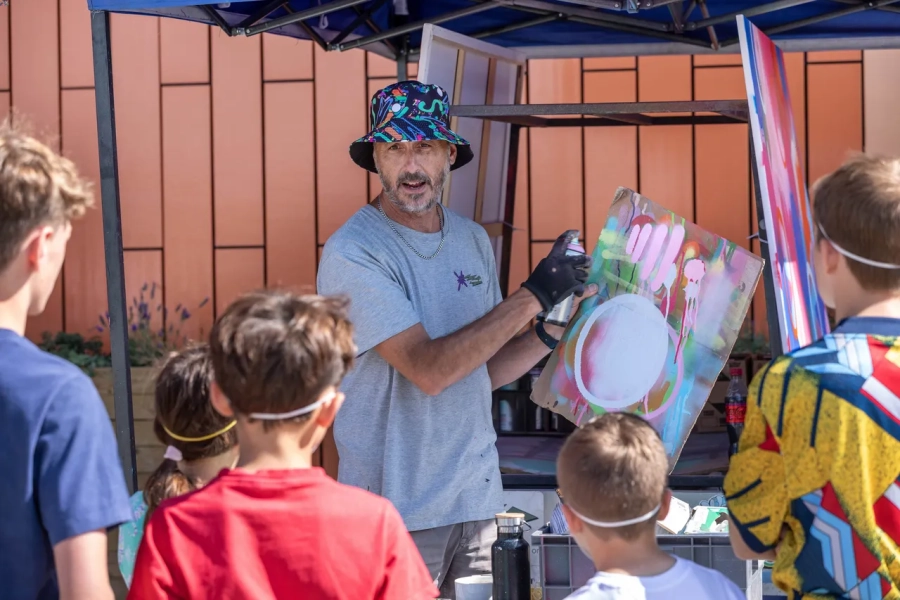
Over the summer, more than 250 young people across St Neots picked up spray cans and paintbrushes to answer a simple question: what does this town mean to you? The result is ‘This Is Our Town Too’, a youth-led graffiti and canvas art project now on display at St Neots Museum.

The project was led by St Neots Town Council’s Youth Engagement team, working alongside St Neots Museum, Places for People and Wintringham, with graffiti artist Kilo of Splash & Dash Creations on hand to guide participants and turn ideas into finished pieces.

Rather than one single event, the project ran as a series of drop-in sessions through early August, taking the art-making out into the places young people already spend time: Kings Road Park, the Duck Lane MUGA, Wintringham School Plaza and St Neots Market Square. Food trucks, an ice cream van and activities from other local organisations turned each session into something of a pop-up community event in its own right.

The idea behind the project is a straightforward one: young people are often talked about rather than talked to when it comes to shaping their town, and can end up feeling like an afterthought in it. Giving them a wall, a canvas and a can of paint flips that around, letting them say directly what St Neots means to them and stake a visible claim to its public spaces.

Youth engagement organiser Hannah Bell, who helped drive the project, has spoken about how many young people say they feel overlooked, and how initiatives like this are a chance to show that they’re valued, active members of the community rather than bystanders in it.

The individual canvases have been brought together into a mosaic-style display, alongside the larger neighbourhood pieces, in an exhibition at St Neots Museum running until 5 September 2026. It’s a rare chance to see the town through the eyes of the people who’ll be shaping its next chapter, and well worth a visit while it’s still up.

The cycling family sculptures at Willow Bridge

Tucked beside Willow Bridge in Riverside Park, three life-sized steel figures greet walkers and cyclists as they cross the River Great Ouse. They look like simple silhouettes at first glance, but each one tells a piece of St Neots’ story, and together they explain why this stretch of riverside path exists at all.

Why they’re here

The sculptures were installed as part of Sustrans’ Connect2 project, the national scheme behind the town’s network of traffic-free walking and cycling routes. Willow Bridge itself was built to link communities either side of the river with a safe, car-free crossing, and the figures were put up to mark that achievement and celebrate the everyday act of getting about on two wheels or on foot.

Three figures, three stories

  • A child playing cricket. Bat raised mid-swing; this figure nods to the willow trees that once grew in the park specifically to supply the cricket bat trade.
  • James Toller, the Eynesbury Giant. Born in 1798, Toller grew to an extraordinary 8 feet 4.5 inches, making him one of the tallest men recorded in England. He remains one of the town’s most retold historical characters.
  • John Cecil Paget. A further notable figure with roots in nearby Eaton Socon, standing alongside Toller and the young cricketer.

The willow and the bat

The cricket bat isn’t a random detail. St Neots was once home to Hunts County Bats, founded by the Trimmins family in 1904 and, for decades, a genuinely sought-after name in English cricket. The willow used to make the bats was grown right here, in plantations along the riverside park, before being harvested and shaped into blades that were shipped out under the town’s name. The business eventually moved to nearby Huntingdon in 1983, but the willow trees, and now this sculpture, keep that piece of local industry visible.

It’s a heritage that still has a local home today. Eaton Socon Cricket Club, which first played at Eaton House back in 1855, has fielded teams from its ground near Peppercorn Lane since 1936, and its Under 11, Under 13 and Under 15 sides still compete in county youth competitions, a living link to the same sport the sculpture commemorates.

A word of warning if the bat looks bare

Being cast as a separate piece, the cricket bat is the most vulnerable part of the group and has occasionally gone missing or been damaged over the years. St Neots Town Council has approved repair works to reinstate it, but don’t be surprised if you spot the young cricketer empty-handed again.

Visiting

The figures stand right on the path at Willow Bridge, making them an easy stop on a riverside walk or a short pause on a longer cycle along the network of traffic-free routes that thread through St Neots. They’re free to visit at any time and sit well alongside a wander through Riverside Park or a longer loop out towards Eaton Socon.

Discover St Neots raises concerns over loss of key town centre parking at Tebbutts Road

Plans were unveiled this month by developer Capital&Centric to transform the Tebbutts Road Car Park into a new neighbourhood of up to 83 homes, set within two five-storey buildings, alongside a walled garden, a community pavilion and commercial space for independent businesses. The scheme is being brought forward with Huntingdonshire District Council, which named Capital&Centric its preferred development partner for regeneration in Huntingdon, St Ives and St Neots in July 2025. As things stand, the proposals would see the Tebbutts Road car park close to public use, with no public parking replacement yet confirmed.

Discover St Neots has a strong, positive working relationship with Huntingdonshire District Council and has supported a number of town centre projects and schemes that have brought investment into St Neots. We want to make clear that we were not involved in drawing up these proposals and, like most residents, only became aware of the detail shortly before it was made public. We strongly support investment in our town. Thoughtful redevelopment can breathe new life into underused areas, attract more visitors, encourage new businesses to open and create more reasons for people to discover everything St Neots has to offer. It’s encouraging to see a developer take a serious interest in this end of the High Street.

However, we also recognise that parking is already one of the biggest concerns for residents, shoppers and businesses in St Neots. Losing a well-used town centre car park naturally raises questions about accessibility and how people will continue to visit and support our High Street, particularly at the Tebbutts Road and Moore’s Walk end of town.

This matters more than most people realise, because of what already sits within a few minutes’ walk of the car park. Moore’s Walk is home to Argos, and to two health services that a great many St Neots residents rely on: the St Neots Health and Walk-In Centre at 24 Moore’s Walk, which sees patients into the evening and at weekends, and mydentist’s Tebbutts Road practice. Cedar House Surgery, on nearby Huntingdon Street, also relies on Tebbutts Road as its closest public car park. People attending a GP appointment, a dental appointment or the walk-in centre are often unwell, in pain, travelling with young children, or simply not able to walk a long distance from parking elsewhere in the town. For these services, losing this car park is not an inconvenience; it is a genuine access issue.

The area is also home to the Priory Centre, St Neots’ main theatre and events venue, whose main auditorium alone can hold over 450 people for a single show. Evening and weekend events there already rely on nearby parking, including Tebbutts Road, at times when much of the rest of the town centre is closed and alternative parking is harder to find. Any reduction in parking provision in this part of town risks making it harder for audiences to get to performances, with a knock-on effect on the venue and on the businesses around it that benefit from evening footfall.

This is not a town centre in decline. Independent MRI footfall data for St Neots town centre shows that, in every month from January to June 2026, year-to-date visitor numbers in St Neots have run ahead of both the East of England and UK high street benchmarks, in a period when footfall across the wider region and the country has generally been falling. By the end of June 2026, year-to-date footfall in St Neots was down just 0.1% on the previous year, compared with a 2.9% year-to-date fall across the East of England and a 2.4% fall nationally. In January alone, footfall was up 3.2% year on year in St Neots, against falls of 4.2% regionally and 3.3% nationally. St Neots is one of the town centres bucking the national trend, and that is precisely why getting this right, rather than simply removing parking, matters so much.

We stand in agreement with many in St Neots that this end of the High Street, Tebbutts Road and Moore’s Walk, has been in decline for some time and would benefit from investment. We support the principle of regeneration here. But growth and accessibility should not be treated as an either-or choice. If this development moves forward, we would like to see equal investment in practical parking solutions, whether that is replacement spaces, improved access to other town centre car parks, or better public transport links, so that the Health and Walk-In Centre, Cedar House Surgery, mydentist, the Priory Centre and the wider High Street remain accessible to the people who depend on them.

Capital&Centric and Huntingdonshire District Council are holding a public consultation event on Tuesday 18th August, between 4pm and 7pm, at Ferro Lounge, 21 Market Square, St Neots. Feedback closes on Friday 4th September, ahead of an expected planning application later this year. We would urge residents, patients, event-goers and local businesses with a stake in this part of town to attend, ask questions, particularly on parking, and make their views known before proposals are finalised.

“St Neots is one of the few town centres genuinely bucking the national trend on footfall right now, and that’s not an accident; it’s down to the people, businesses and services that draw people into the town. We welcome investment in St Neots and recognise that Tebbutts Road and Moore’s Walk need new life. But regeneration has to work for the people, patients and businesses already here, not just for the new homes going up. This is the part of town where residents go for a GP appointment, a dental check-up, an urgent walk-in appointment, or an evening at the Priory Centre. Losing that car park without a clear, credible replacement would make daily life harder for exactly the people this end of town exists to serve, and risks the very growth we’re trying to protect. We want to see this development succeed, but not at the cost of accessibility for the health services and venues that St Neots relies on.”

Richard Slade, co-founder, Discover St Neots.

SugaSpice Bakery and Kitchen opens its doors in St Neots

A new independent bakery and kitchen has opened in St Neots, with owners Raj and Ioana welcoming the town through their doors for the first time on Saturday.

SugaSpice Bakery & Kitchen held its grand opening on Saturday 8 August, and Deputy Mayor Cllr Sam Smith called in to mark the occasion, pictured here with Raj and Ioana at the new premises.

The new venue combines the familiarity of a traditional bakery with the variety of a modern kitchen. On offer are freshly baked bread and rolls, breakfasts, premium filled sandwiches, cakes and coffee, alongside smash burgers, fried chicken and bold Indian-inspired dishes, served throughout the day.

Behind SugaSpice is a team who have put months of hard work and personal investment into bringing the business to life. Their aim is to create a friendly, welcoming spot with something for everyone, and to become part of the fabric of the St Neots community, creating local jobs, working with other independent businesses in the town, and supplying fresh bakery and grab-and-go products to local retailers, cafés and organisations.

As a brand new independent business, SugaSpice will be relying on local support to get known. Head down to 10 Moores Walk to have a look around, meet the team, and try what’s on offer.

St Neots Day: the story behind our town’s name

Every year on 31 July, St Neots marks the feast day of the saint who gave the town its name. It’s a good moment to look back at the unlikely story of how a Cornish hermit came to be remembered on the banks of the Great Ouse.

Who was Neot?

Neot was born in Wessex in the early 9th century and trained as a monk at Glastonbury Abbey, where he became known for his scholarship and humility. Uneasy with the attention his reputation brought him, he left Glastonbury and travelled to a remote spot in Cornwall, in what is now the village of St Neot, near Bodmin Moor. There he lived as a hermit for seven years before a visit to the Pope in Rome, who encouraged him to found a monastery on the site and continue his ministry rather than withdraw further from the world.

Neot became known for his care of the poor and his devotion to prayer. King Alfred the Great is said to have visited him at Cornwall on several occasions, and Neot was not shy of admonishing the king over his conduct. A number of miracles were later attributed to him, including one in which he refused to break a promise made to him by an angel about three fish in a holy well, a story still depicted in the medieval stained glass of St Neot’s parish church in Cornwall today.

Neot died on 31 July 877, which is why his feast day falls on that date. His body was buried at the monastery he had founded.

From Cornwall to Eynesbury

Around a century after his death, a nobleman named Leofric founded a new priory at Eynesbury, on the banks of the Great Ouse, and wanted a notable saint’s relics to give the foundation prestige and draw pilgrims. Neot’s remains were taken from Cornwall, reportedly without permission, and brought here. Despite the objections of the Cornish, who pursued the theft and even took the matter to the king, the relics stayed at Eynesbury.

A chapel and monastery were built to house them, and the settlement that grew up around the priory took on a new name in the saint’s honour: St Neots.

A legacy that lasts

The priory itself was destroyed at the Dissolution of the Monasteries in 1539, and no trace of Neot’s remains survives today. But his name endures in the town, and his image, taken from the Alfred Jewel, appears in the mosaic set into the paving of the Market Square.

More than a thousand years on, St Neots Day is a chance to celebrate that history and the values of care and community that the saint was remembered for.

Free after 4pm parking could bring a boost to St Neots town centre

St Neots could be set to benefit from free parking in council-run car parks after 4pm on weekdays, following a funding agreement between the Cambridgeshire and Peterborough Combined Authority and Huntingdonshire District Council.

Subject to cabinet approval on 14 July, the scheme would run from 1 October this year through to the end of March 2028 — a time-limited trial designed to bring more people into town during the early evening.

For St Neots businesses, that window is significant. The after-school period is already one of the busier times of day in the town centre, with families heading in after pick-up. Removing the cost of parking could encourage more of those visits to turn into a coffee stop, a browse around the shops, or a meal out — translating footfall into real spend for local traders.

The £1.5 million scheme, funded through the Mayor of Cambridgeshire and Peterborough Paul Bristow’s 2026/27 budget, aims to ease some of the pressure that high streets across the country have been feeling. St Neots, along with Huntingdon, Ramsey and St Ives, is named as a direct beneficiary. Mayor Bristow said the rationale was straightforward:

“Free parking removes at least one barrier to more people coming in and supporting what’s on their doorstep, strengthening our local economy.”

The initiative also sits neatly alongside the region’s growing ambitions for tourism. The Cambridgeshire and Peterborough Combined Authority recently received Local Visitor Economy Partnership (LVEP) status from VisitEngland — a formal recognition that supports efforts to grow visitor numbers and spending across the area. Making town centres more accessible in the evenings is a natural complement to that work.

Huntingdonshire District Council leader Sarah Conboy welcomed the proposal, noting its potential to encourage residents and visitors alike to spend more time in town centres later in the day.

The cabinet meeting takes place on 14 July, with a report already published on the HDC website ahead of both Overview and Scrutiny and Cabinet consideration.