Beneath the forecourt: the hidden history of 26 Cambridge Street
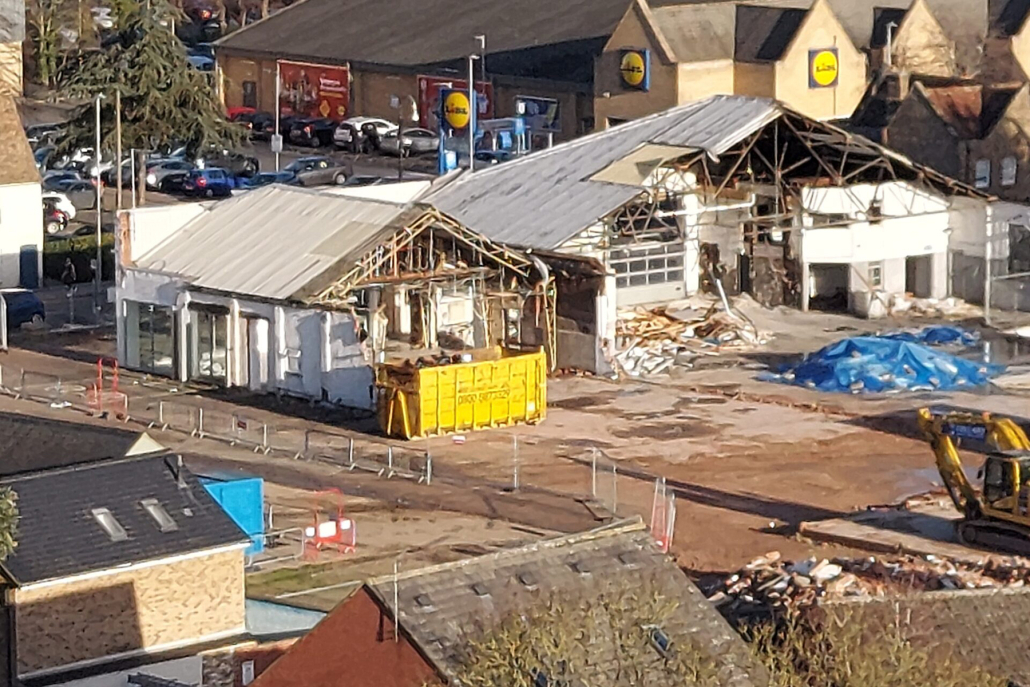
Drive along Cambridge Street, and the car sales and service site at No. 26 has now disappeared. What once looked like the least historic spot in St Neots, with metal-clad showrooms, workshops and a sea of tarmac, has a secret. There is nothing here to list or photograph. But the ground under the forecourt sits right next to one of the most important archaeological sites in the town, and possibly in the country, and plans to redevelop it mean we may soon learn a lot more about what lies beneath.
Where archaeological history was made
Between 1929 and 1932, gravel was being dug from the land just to the east and southeast of the site. A local antiquarian, C F Tebbutt, kept a close eye on the quarrying and recorded what turned up. What he found was remarkable: the remains of an Anglo-Saxon settlement, complete with houses, farm and workshop debris and a burial. Tebbutt’s work recorded the first evidence of Anglo-Saxon sunken-floored buildings found in England, a type of house archaeologists now know from sites across the country. It was also here that a distinctive type of late Saxon pottery was first identified, and it has carried the town’s name ever since: St Neots Ware.
Later digs filled in the picture. In 1961 the archaeologist Peter Addyman excavated nearby and found more Saxon buildings, including a large boat-shaped timber hall and parts of several other structures. Further work in 1999, and a major excavation by Archaeological Solutions in 2007 on land just south of the site, recorded more than 400 archaeological features covering eight phases of activity, from the late Neolithic right through to the 20th century.
Four thousand years in one corner of town
Taken together, these excavations show that people have been drawn to this spot, between the Hen Brook, the Fox Brook and the River Great Ouse, for a very long time. The earliest find from the 2007 dig was a pit containing a near-complete collared urn from the late Neolithic or early Bronze Age. Earlier still, Tebbutt’s quarry produced flint tools and the bones of red deer, rhinoceros and bison, though these were probably washed into place by ancient ice and meltwater rather than left by people.
In the Roman period the area seems to have been farmland, with small enclosures or pens for animals, pottery, butchered animal bone and a fourth century coin. It may have been an outlying part of the Roman villa at Eynesbury.
The Saxon settlement that followed was substantial. It appears to have been at least partly planned, enclosed by a ditch along the south side of Cambridge Street and the east side of Church Street, and may have covered up to 8 hectares. Finds include clay loomweights for weaving, quernstones for grinding grain, a bone comb, a ploughshare and evidence of pottery making. The 26 Cambridge Street site is thought to lie within or alongside this settlement.
Fishponds, a grand house and a nursery
In the medieval period the heart of St Neots moved west towards the priory and the Market Square, and this area became something of an industrial fringe, with evidence of metalworking and furnaces at the corner of Cambridge Street and Church Street. A medieval fishpond excavated just to the south appears to continue into the site. Its waterlogged mud preserved leather shoes and the wooden stakes and planks that lined its sides.
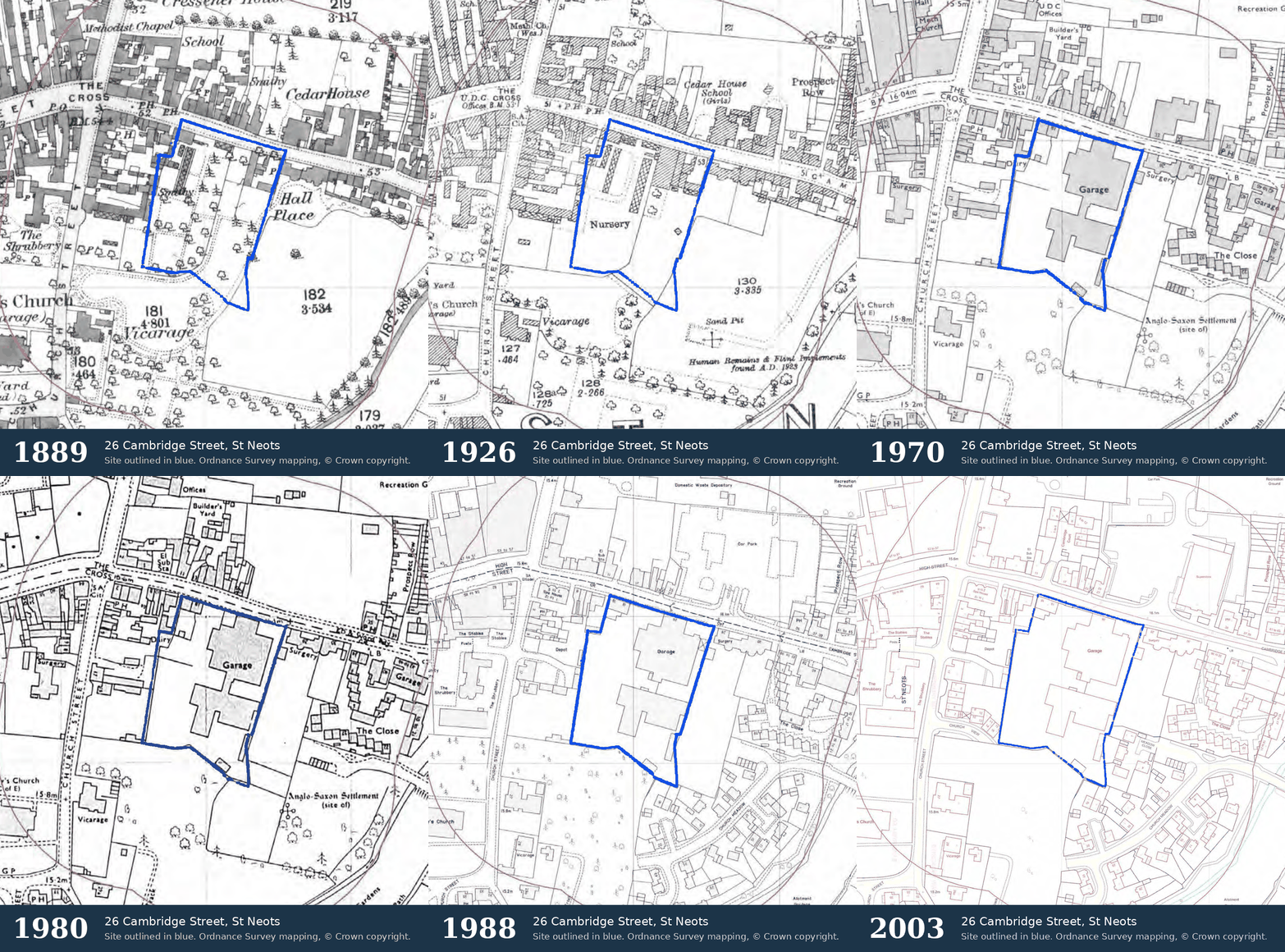
By the late 17th or early 18th century the land formed part of the grounds of Hall Place, a wealthy house described in 1772 as “the capital messuage in St Neots”. The house was later pulled down, though its gates and garden walls survive, and its name passed to the Grade II listed house that stands just east of the site today. Victorian maps show the site itself as a mix of parkland with lawns and trees, nursery greenhouses, outbuildings and a smithy facing Cambridge Street. The garage arrived in the first half of the 20th century, and by 1970 it had spread across the whole plot, while the nursery that had survived into the post-war years had gone.
What happens next
Plans drawn up in 2023 propose clearing the garage buildings and building a retirement living development, with a main building facing Cambridge Street and cottages to the rear. The site lies within the St Neots Conservation Area, and the accompanying heritage statement concludes that the current buildings detract from the street, so a well-designed replacement could improve this stretch of Cambridge Street.
Underground, the story is more intriguing. Archaeologists have never dug on the site itself. Decades of building, fuel tanks and levelling will have disturbed parts of it, but the desk-based assessment concludes there is a high chance that Saxon and medieval remains survive between the disturbed areas, just as they did on the neighbouring land. Because of the site’s links to Tebbutt’s discoveries, any Saxon remains found here are judged to be of medium to high significance. Human remains have also been found close by, so burials cannot be ruled out.
The empty forecourt that thousands of people drive past every week reveals a new chapter in the story of Saxon St Neots, almost a century after Tebbutt first spotted those sunken floors in the gravel pit next door.

