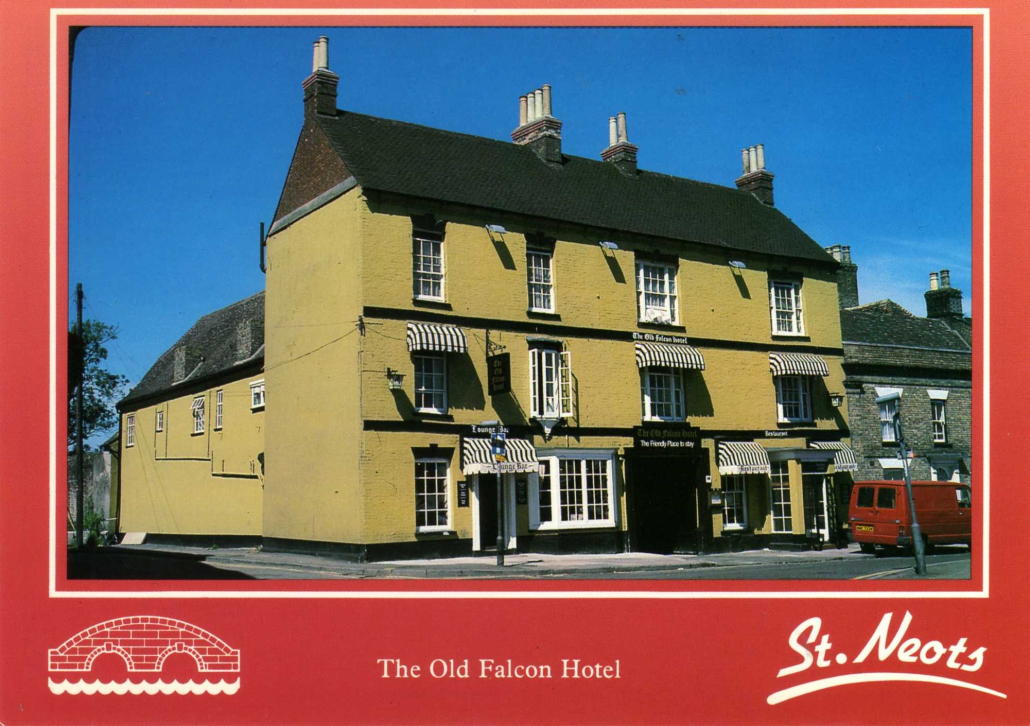
The Old Falcon: a new chapter for one of St Neots’ oldest buildings
Stand in the Market Square and look west towards the bridge, and the Old Falcon fills the corner in front of you: three storeys of painted brick, a central carriage arch, neat rows of sash windows and a small curved oriel window on the first floor. For around twenty years it has stood empty, its paint peeling and its windows boarded. Now plans to restore it have been approved, and one of the oldest buildings on the Market Square is set to come back to life.
Older than it looks
The smart frontage facing the square is something of a disguise. Behind it, the southern end of the building dates back to the late 15th century, making the Old Falcon one of the earliest surviving buildings in the square. The part north of the carriage arch is largely 17th century, possibly with earlier timbers inside, and the long wings running back towards the river were added in the late 1600s. The brick front came much later, as Georgian and then early 19th-century owners gave the old timber-framed building a fashionable new face, a pattern repeated right across St Neots.
The layout of the site tells an even older story. The Market Square was laid out by the priors of St Neots in the 12th century, and the Old Falcon sits on two of the long, narrow medieval plots that once ran from the square down to the River Great Ouse, either side of a passageway that survives today as the carriage arch.
Inside, the surviving rooms still carry that history. The ground floor room at the south-east corner has heavy, ornately moulded ceiling beams and large open brick fireplaces at either end, along with what is thought to be an original jowled corner post, a feature typical of medieval timber framing.
Coaches, horses and the Great North Road
The first written record of the inn dates from 1693. St Neots was prospering at the time: the river had become navigable around 1630, bringing grain and goods into the town, and the Great North Road was carrying a growing stream of travellers. In 1753 Mary Stacie, a spinster of Hackney, sold the inn to John Bailey. By 1792 Thomas Small was the landlord, followed by Suzanna Small, and in 1809 the property included stables and a yard with nine grain stores.
By 1823, under William Thornton, the Old Falcon was a posting house, where travellers could rest and change horses for the next stage of their journey. In 1830, under George Briggs, the Perseverance coach called every afternoon on its route to and from Boston, one of several coaches including the Regulator, the Regent and the Rockingham that passed through St Neots in the coaching age.
The arrival of the railway in the mid 19th century brought that trade to an end. The inn went into decline and let off its valuable frontage to tenants, while a cottage in the yard became the public house. From around 1825 the part north of the archway was home to a veterinary surgeon, Thomas Levi Wilmer Gaudwell. South of the arch, William Lee, plumber and glazier, took one shop in 1848, and in 1854 Henry Elkins, tailor and draper, opened at the corner, staying for over fifty years until he retired around 1906.
It was not until after 1938 that Miss Betty Jewson brought the whole building back together as a hotel. A 1940s photograph shows the St Neots Home Guard lined up outside, and later decades added a porch and, by the 1980s, a set of striped Dutch canopies that many people in the town will remember. The Old Falcon closed around 2005 and has been empty ever since.
Down by the river
At the far end of the site, right on the riverbank, is one of its most charming survivors: a 19th century brick cottage known as the boat house, with an undercroft below that once let boats come in straight from the river. It is easy to spot from the town bridge and from Riverside Park, and it gives the Old Falcon a second face, looking out over the Ouse rather than the Market Square.
What happens next
The scheme is a partnership between the building’s owner, Whitfield Property Investment Ltd, and Huntingdonshire District Council, through the Future High Streets Fund. It forms part of a wider investment of around £15 million in St Neots town centre, which also covers the Market Square, High Street, the bridge and the Priory Centre.
The plans will create two commercial units facing the Market Square, using the existing shopfronts either side of the carriage arch, with the historic beams, floors and brick fireplaces kept on show inside. Behind and above them will be 14 new town centre homes. The front windows will be carefully repaired, or copied exactly where they cannot be saved, and the frontage repainted. The boat house will become two flats with balconies over the river. Run-down 20th century additions at the back will be replaced with new buildings that step down towards the river and echo the stables and stores that stood on the site in the 1940s. The old yard will become a quiet, landscaped courtyard with a tree at its western end.
None of this will be quick or simple. Years of water getting into the building have left areas of dry rot and decay, particularly in the south wing, and specialist surveys have set out a careful programme of timber repairs. Archaeologists have also flagged a moderate to high chance of medieval and later remains surviving below ground, so groundworks will be watched closely, and may yet turn up new clues about the town’s past.
For now, next time you are in the Market Square, take a moment to look up at the Old Falcon. Picture the coaches rattling in under the arch, the tailor at work in his corner shop and the boats slipping in beneath the cottage by the river. After two decades of waiting, its next chapter is about to begin.

